The Decile System

What is the Aim of the Decile System?

The decile system is a scoring system used by the Ministry of Education to determine the financial needs of public schools. Each school is assigned a rating between one and ten depending on the percentage of enrolled students from low socio-economic backgrounds. A higher score indicates less students from low socio-economic backgrounds and the school is allocated less funding (Education, 2019).

The decile system was implemented in 1995 with the purpose of distributing government funding in a way which helps to provide extra support to learners from disadvantaged communities. The system aims to give extra support to those who are disadvantaged in order to provide equal opportunities for the success of all students (PPTA, 2013). However, the decile system is commonly misinterpreted as being a reflection of a difference in the quality of the education provided at different schools. Parents often avoid sending their children to lower decile schools in favour for a higher decile, as they believe their child will have better academic success at a higher decile school.

Is Decile Score Synonymous with Quality?

When comparing the average NCEA grades achieved at schools of different decile rates, it is evident that lower decile schools achieve, on average, lower grades than higher deciles schools. However, according to Thrupp and Alcorn (2011) comparing school achievement in a decile-based context is “a case of using available data rather than good data.”

Children from low socio-economic communities face many more obstacles on the road to academic success than children from more privileged backgrounds. As low decile schools have a higher percentage of disadvantaged children than their high decile counterparts, directly comparing the average NCEA results of these schools is to neglect the inequality of preparedness between children of high and low socio-economic status. In order to fairly compare the quality of education provided by each school, one must also take into account the starting position of the students within the school. To compare academic success based on the end point of the child’s education alone would be a gross misrepresentation of the obstacles each child has had to overcome in order to arrive at the destination.

Also, as there is no difference in the level of qualification needed to teach at schools of different decile levels, both high and low decile schools draw their teaching staff from the same pool. This suggests that there is no difference in the quality of teaching between schools of different decile levels (ERO, 2016).

While on the surface it may appear that the decile rate of a school corresponds to student success, this is not a true reflection of the quality of education provided by the school. Therefore, comparing the average NCEA results between school does not fairly represent the quality of teaching or the success of the schools ability to teach the child, instead this difference in achievement highlights the importance of providing additional support to disadvantaged children, as is the aim of the decile system (PPTA, 2013).

References

Education. (2019). School Deciles. Retrieved from https://www.education.govt.nz/school/funding-and-financials/resourcing/operational-funding/school-decile-ratings/

Education Review Office. (2016). High Quality Education and Care – An Overview. Retrieved from https://www.ero.govt.nz/publications/quality-in-early-childhood-services/high-quality-education-and-care-an-overview/

PPTA. (2013). A Hierarchy of Inequality – The Decile Divide. NZPPTA. Document 338. Retrieved from https://www.ppta.org.nz/dmsdocument/338

Thrupp, M., & Alcorn, N. (2011). A Little Knowledge Being a Dangerous Thing?: Decile-based Approaches to Developing NCEA League Tables. New Zealand Annual Review of Education. 20(2010), 52-73. Retrieved from https://www.victoria.ac.nz/education/research/nzaroe/issues-index/2010/pdf/text_thrupp.pdf
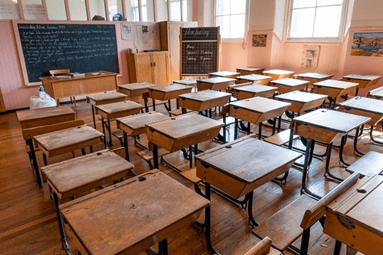
A Sceptic in the Innovative Learning Space.

Innovative classrooms are becoming more and more popular in schools, but what does this term really mean? Perhaps, it is easier to explain what an innovative classroom is not! If your image of a classroom is rows and rows of single desks all facing the same direction, with a teacher podium at the front of the room, you are not picturing an innovative classroom! The innovative classroom has no template to follow, it can be anything you like.

Innovative classrooms are becoming more and more popular in schools, but what does this term really mean? Perhaps, it is easier to explain what an innovative classroom is not! If your image of a classroom is rows and rows of single desks all facing the same direction, with a teacher podium at the front of the room, you are not picturing an innovative classroom! The innovative classroom has no template to follow, it can be anything you like.

For me, the first experience of an innovative classroom was walking into my practicum school, I was presented with a colourful room filled with clusters of tables: Some low to the ground with soft chairs, some tall, café style tables with high stools, some tables were more like a traditional 4 seaters and some allowed students to sit in pairs. Students were free to sit wherever they wanted, they could choose to sit in large groups or alone. Not only could they sit wherever they wanted, but it appeared they were also free to move and rearrange the furniture however they wanted. The next thing I noticed was that there was no teachers desk or obvious place in the room for the teacher to be based. Large whiteboards took up 3 walls and the 4th wall was not a wall at all, but a row of foldaway dividers hanging from the ceiling that could be hidden away to allow two small classrooms to be transformed into one large room.

Had I seen this room in any other context I would have thought it looked exciting, vibrant and inviting. However, to my surprise, the first thought that popped into my head was “Oh no! How am I meant to get the students attention when they are all sitting in large groups facing each other?” I had images in my mind of student arguing over the “coolest” seats or bickering about who is going to sit with who. My initial instinct was to be nervous about how the set out of the room would hinder the effectiveness of my teaching. Would it be impossible to get everyone’s attention when no matter where I placed myself in the room, some of the students would have their backs to me?

As I began to observe my first class, I noticed that many of the issues I feared were unfounded. Students came into the room just like in any other, they took their seats and quickly reshuffled chairs to fit their needs. As the teacher based himself in front of one of the whiteboards and began addressing the class, the students simply swivelled in their chairs to face the direction he was addressing them from. The teacher walked about the classroom introducing different tasks as students swivelled and readjusted their position to keep their eyes on him, it felt almost like watching a strange, slow motion game of tennis.

I realised that this type of seating arrangement had some benefits. Students were unable to sit at the back of the class hoping to go unnoticed as the room had no front and no back. This encouraged the teacher to rotate around the room and spend time with all students, or place himself near some distracted students to help keep them on task without disrupting the rest of the class. As the lesson continued, I noticed that some students would take the initiative to move seats, maybe to get a better look of the whiteboard, move away from an unwanted distraction, or move into a more comfortable position. This allowed students the freedom to manage themselves and encouraged them to use their initiative. Overall, I noticed that the students seemed happy and relaxed in the room and appeared to have a positive association with the space.

The setup, however, was not without its flaws. Allowing students to sit in large groups sometime meant that individuals would hide in the crowd, sitting back at letting other students do the work rather than actively contributing. This required the teacher to monitor groups and sometimes split up a large group into smaller clusters. It also meant that students tended to gravitate towards their friends and would work with the same group of students each day. This also required the teacher to be creative in some tasks, ensuring that students had the experience of working with others.

All in all, my opinion of an innovative learning space went from one that was very sceptical, to seeing first-hand some of the benefits it provides.