Innovative classrooms are becoming more and more popular in schools, but what does this term really mean? Perhaps, it is easier to explain what an innovative classroom is not! If your image of a classroom is rows and rows of single desks all facing the same direction, with a teacher podium at the front of the room, you are not picturing an innovative classroom! The innovative classroom has no template to follow, it can be anything you like.
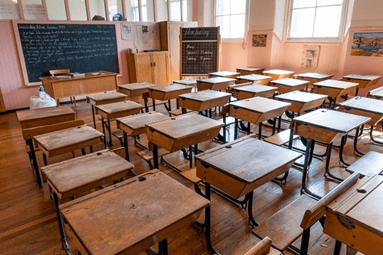
Innovative classrooms are becoming more and more popular in schools, but what does this term really mean? Perhaps, it is easier to explain what an innovative classroom is not! If your image of a classroom is rows and rows of single desks all facing the same direction, with a teacher podium at the front of the room, you are not picturing an innovative classroom! The innovative classroom has no template to follow, it can be anything you like.
For me, the first experience of an innovative classroom was walking into my practicum school, I was presented with a colourful room filled with clusters of tables: Some low to the ground with soft chairs, some tall, café style tables with high stools, some tables were more like a traditional 4 seaters and some allowed students to sit in pairs. Students were free to sit wherever they wanted, they could choose to sit in large groups or alone. Not only could they sit wherever they wanted, but it appeared they were also free to move and rearrange the furniture however they wanted. The next thing I noticed was that there was no teachers desk or obvious place in the room for the teacher to be based. Large whiteboards took up 3 walls and the 4th wall was not a wall at all, but a row of foldaway dividers hanging from the ceiling that could be hidden away to allow two small classrooms to be transformed into one large room.
Had I seen this room in any other context I would have thought it looked exciting, vibrant and inviting. However, to my surprise, the first thought that popped into my head was “Oh no! How am I meant to get the students attention when they are all sitting in large groups facing each other?” I had images in my mind of student arguing over the “coolest” seats or bickering about who is going to sit with who. My initial instinct was to be nervous about how the set out of the room would hinder the effectiveness of my teaching. Would it be impossible to get everyone’s attention when no matter where I placed myself in the room, some of the students would have their backs to me?
As I began to observe my first class, I noticed that many of the issues I feared were unfounded. Students came into the room just like in any other, they took their seats and quickly reshuffled chairs to fit their needs. As the teacher based himself in front of one of the whiteboards and began addressing the class, the students simply swivelled in their chairs to face the direction he was addressing them from. The teacher walked about the classroom introducing different tasks as students swivelled and readjusted their position to keep their eyes on him, it felt almost like watching a strange, slow motion game of tennis.
I realised that this type of seating arrangement had some benefits. Students were unable to sit at the back of the class hoping to go unnoticed as the room had no front and no back. This encouraged the teacher to rotate around the room and spend time with all students, or place himself near some distracted students to help keep them on task without disrupting the rest of the class. As the lesson continued, I noticed that some students would take the initiative to move seats, maybe to get a better look of the whiteboard, move away from an unwanted distraction, or move into a more comfortable position. This allowed students the freedom to manage themselves and encouraged them to use their initiative. Overall, I noticed that the students seemed happy and relaxed in the room and appeared to have a positive association with the space.
The setup, however, was not without its flaws. Allowing students to sit in large groups sometime meant that individuals would hide in the crowd, sitting back at letting other students do the work rather than actively contributing. This required the teacher to monitor groups and sometimes split up a large group into smaller clusters. It also meant that students tended to gravitate towards their friends and would work with the same group of students each day. This also required the teacher to be creative in some tasks, ensuring that students had the experience of working with others.
All in all, my opinion of an innovative learning space went from one that was very sceptical, to seeing first-hand some of the benefits it provides.
 Miss Smith's Provocations Blog
Hi Karly,
I have not been in a classroom as you described in your post before, however, I would love to implement this style in my future class if I have a chance. My initial though is that this type of learning space is not only different from a traditional classroom but also promoting the idea of “freedom of choice” in student. As per my personal philosophy, everyone should have a choice in everything in life. As a future educator, I believe that giving choices to my students is important and essential as much as the curriculum study. The choice starts with something small, such as how they seat, to something bigger such as how they work with others and how they learn. Only when they can make decisions by choosing the best option for them, they can grow.
Besides the physical appearance of the classroom, the most important thing must be our mindset which will be reflected in our pedagogy. Regardless of how cool the tables and chairs are, if we, as the teachers, cannot find the meaning of it or align our teaching pedagogy that encourages innovative thoughts in our students, the outcomes would be no difference with the traditional learning. If a teacher has an innovative mind, he or she could turn a traditional lesson into the innovative lesson without moving a thing. After my practicum, I have learnt that sometimes the most innovative ideas will come out when you are in lack of resources. In my class, I told my students to bring their favourite empty tin/box/container from home to use in a geometry lesson and it turned out that they love the idea of choice and seeing others working with a range of different things.
Overall, I can see a lot of benefits that come out from this innovative learning space and I wish I could have one class like this in the future.
LikeLike
Hehe, I also wrote something on innovative learning spaces, but my perspective on this is somewhat different from yours.
I’m not against trying this out as a teaching and learning environment, but I can’t help but have a feeling of disconnect between teachers, upcoming teachers, students, parents, and the government. Who is this really for? Why is this becoming a thing? And why is there quite a bit of resistance to the changes? My perspectives were on the larger context of this being a government initiative rather than a teacher’s experience in the space.
Which means I find the experiences of different teachers on this topic very interesting. I, myself, had not experienced this yet, but the near future…
And from what I’ve heard so far, this has been such a polarising topic even amongst teachers that I’m withholding any judgements until I’ve experienced it myself. It will definitely be great to have a space that is free to be remodelled/rearranged at will and I look forward to trying out a few strategies that I hope will work in such environments. And Katie do have a point that such environments might trigger our creative potential in coming up with better ways to utilise our environments.
But experiences aside, I still think that our current assessment system is somewhat at odds with what innovative learning environments are trying to accomplish. Promoting group work and collaborative/co-operative learning throughout the years only to have the students go at exams alone feels odd to me.
LikeLike